









How much does it actually cost to live in a share house?
When considering a share house, the question most people have is, "How much will I actually be paying every month?"
Property listings often highlight figures like "40,000 yen rent" or "50,000 yen rent," but the amount you pay is not always limited to just the rent.
In share houses, there are often additional costs such as common service fees, utility costs, and management fees. Furthermore, you may need to pay security deposits or contract fees when moving in.
Therefore, when thinking about share house expenses, it is important to divide them into two categories: "How much is needed to move in?" and "How much will I pay every month?"
In this article, we will explain the cost structure step-by-step to make it easy to understand for those looking for a share house for the first time.
Share house costs are divided into "Initial Costs" and "Monthly Costs"
First, it is important to know that share house expenses are broadly divided into "money needed at move-in" and "money needed every month after moving in."
At the time of move-in, depending on the property, there may be charges for security deposits, contract fees, administrative fees, and insurance premiums.
On the other hand, after moving in, you may need to pay not only rent but also common service fees, utility costs, and management fees.
However, the names, amounts, and what is included in these fees vary by property. In other words, it is important not to judge a property as "cheap" based solely on the rent.
What are the initial costs?
With standard rental housing, you often need a lump sum at the time of contract for security deposits, key money, brokerage fees, guarantee company fees, and fire insurance premiums.
While share houses also require upfront costs, the details vary by property. For example, you may be charged for a security deposit, contract fee, move-in administrative fee, key replacement fee, and insurance or coverage-related fees.
On the other hand, some properties keep initial costs low through special campaigns.
What you should be careful about here is not to assume that "share house initial costs are always cheap." Once you find a property you are interested in, be sure to confirm exactly how much you need to have ready by your move-in date.
Is rent the only monthly cost?
Next, you should check the expenses you will pay every month after moving in.
While rent is the base, share houses may add common service fees, utility costs, and management fees to this amount.
For example, if a property has a rent of 50,000 yen and a common service fee of 15,000 yen, your basic monthly burden will be 65,000 yen.
Furthermore, your actual living expenses will depend on whether that 15,000 yen includes electricity, gas, water, and internet, or if those must be paid separately.
That is why, when comparing properties, it is important to look at the "total monthly payment" rather than just the rent.
What is included in the common service fee?
Many people wonder, "What is the common service fee used for?"
This also varies by property, but in many share houses, the common service fee or monthly fee covers costs such as electricity, gas, water, internet, cleaning of common areas, and consumables like toilet paper.
On the other hand, some properties set utility and management fees separately from the common service fee.
In other words, "high common service fee" does not necessarily mean "expensive." You need to check exactly what is included before comparing.
Consider "non-rent" costs when comparing with living alone
When comparing the costs of a share house versus living alone, looking only at rent makes it difficult to see the actual financial burden.
When starting to live alone, you often have to provide your own furniture, appliances, curtains, lighting, and cooking utensils.
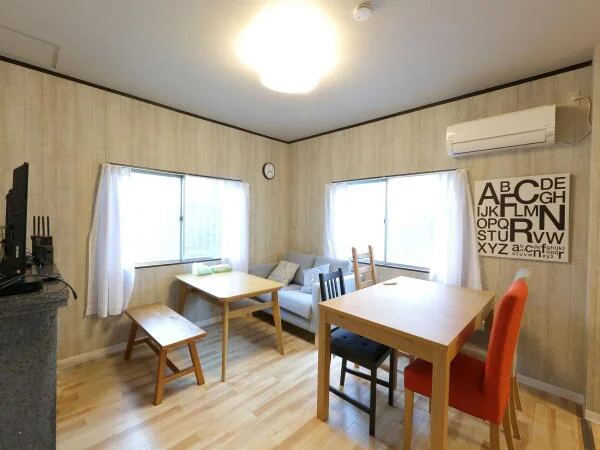
In a share house, many properties provide private rooms equipped with beds and desks, as well as shared facilities like refrigerators, microwaves, rice cookers, cooking utensils, and washing machines.
Therefore, when comparing, it is easier to understand the actual burden if you include "money needed before moving in," "money paid every month," and "furniture/appliances you have to provide yourself."
Don't decide on a property based solely on price
Many people consider share houses because they want to keep costs down.
Of course, budget is important, but we do not recommend choosing a property based on a difference of just a few thousand yen.
For example, even if the rent is cheap, you may feel dissatisfied after moving in if it is far from the station or if the private room and shared facilities do not meet your needs.
Conversely, even if the monthly cost is slightly higher, it may be worth it if it includes internet, utilities, and cleaning services, and provides convenient facilities for you.
It is important to think not just about "finding a cheap property," but "finding a property that meets your criteria within your budget."
5 costs to check when comparing properties
Once you find a share house you are interested in, check at least these 5 points:
① Total amount of money required at move-in
② Monthly rent
③ Common service fees, management fees, and utility costs
④ What is included in the common service fees, etc.
⑤ Whether there are separate fees for contract periods or moving out
It is especially important to clarify "how much initially" and "how much monthly." If there are any unclear costs, confirm them with the management company before signing the contract.
Summary | Compare share houses by "total cost," not just rent
The cost structure of a share house varies depending on the property.
The key to finding a property that fits your budget is to look beyond just the rent and compare the total cost, including initial fees, common service fees, utility costs, and management fees.
Also, since common service fees may include utilities, internet, and cleaning costs, be sure to check the breakdown rather than just the amount.
At Share Clip, you can check the rent, initial costs, and monthly fees on the details page of each listed property.
While comparing several properties, think about "how much I need initially and how much I can comfortably pay every month" to find the share house that is right for you.